Photo: space.com
JWST spots dust-cloaked 'red supergiant' star just before it went supernova
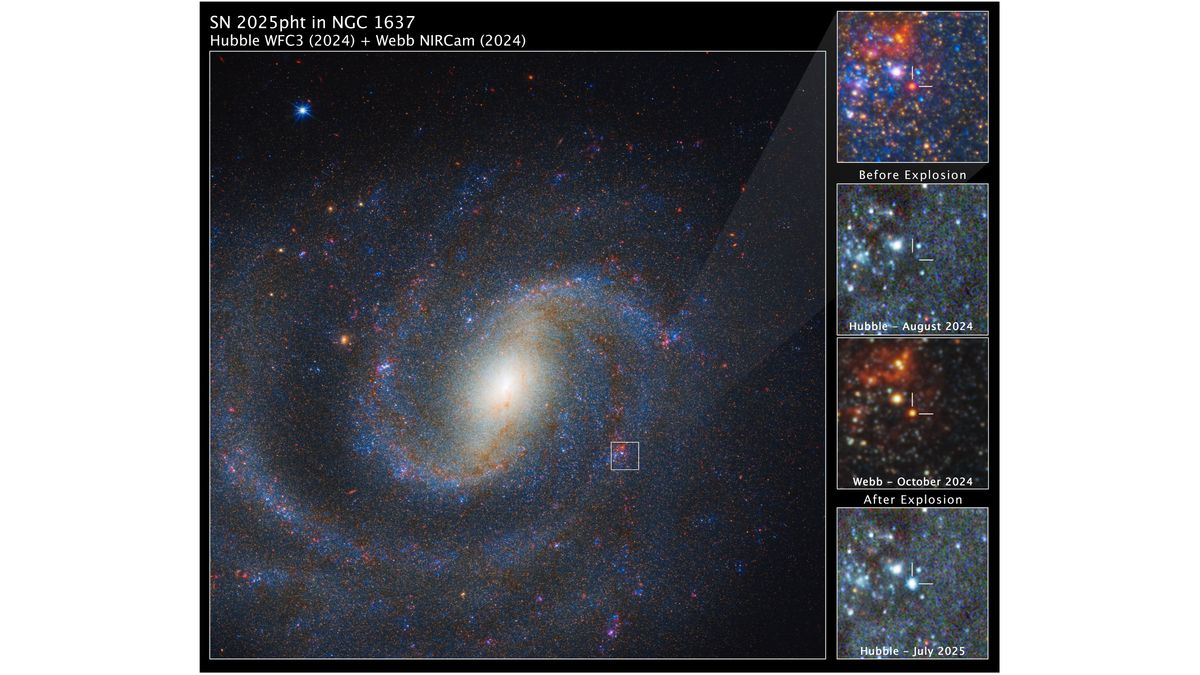
The James Webb Space Telescope detected a dust-enshrouded red supergiant star just before it exploded as supernova SN 2025pht, providing unprecedented insights into stellar evolution.
- The red supergiant star, identified as the progenitor of supernova SN 2025pht, was previously obscured in infrared light and only visible through the James Webb Space Telescope.
- Located in the spiral galaxy NGC 1637, the discovery highlights JWSTs capabilities, revealing details that the Hubble Space Telescope could not capture prior to the explosion.
- This event marks a significant moment for astronomers, including those from Northwestern University, as it provides data on the lifecycle of massive stars and their explosive deaths.
Why It Matters
This discovery enhances our understanding of stellar dynamics and supernovae, bridging gaps in astronomical knowledge about star formation and death. It also showcases the advanced capabilities of NASAs James Webb Space Telescope in exploring the universe.